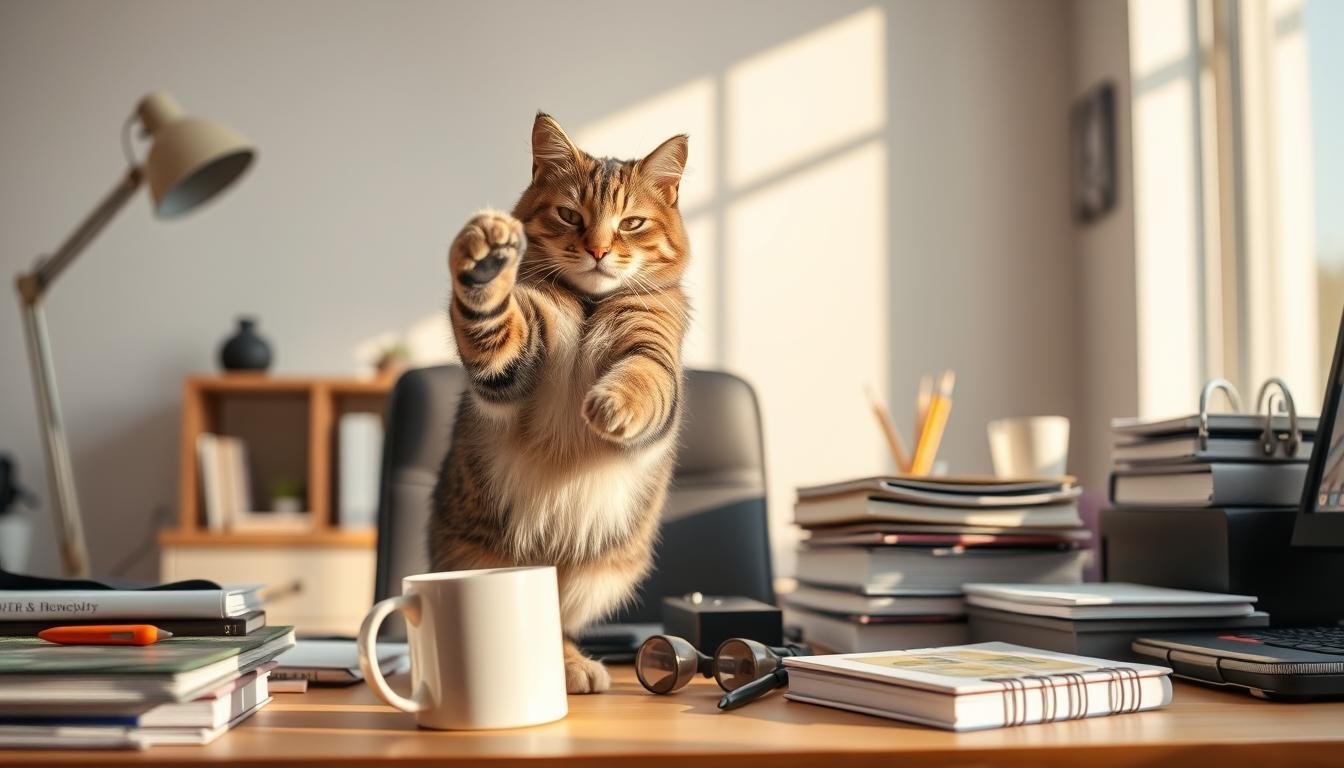
Ever think your cat is secretly planning to empty every shelf? Or is there a real reason behind their paw swipes?
When your cat knocks a mug off the counter, it might seem like they’re up to no good. But, it’s actually a sign of their natural hunting instincts and learning habits.
Kittens use movement to practice stalking and pouncing. Adult cats keep knocking things to get your attention, to make sounds, or to break the monotony of being indoors.
This article will explore the science behind it. We’ll look at what experts say, and how to stop it. We’ll also talk about when to seek help if your cat’s behavior is a sign of stress or illness.
Key Takeaways
- Knocking items is often rooted in hunting instincts and sensory testing.
- Cats learn attention‑seeking by observing human reactions.
- Boredom and indoor living increase the chance of object‑toppling.
- Environmental enrichment and training can reduce unwanted behavior.
- Consult a vet or certified behaviorist if the behavior escalates or seems linked to anxiety.
why do cats knock things over
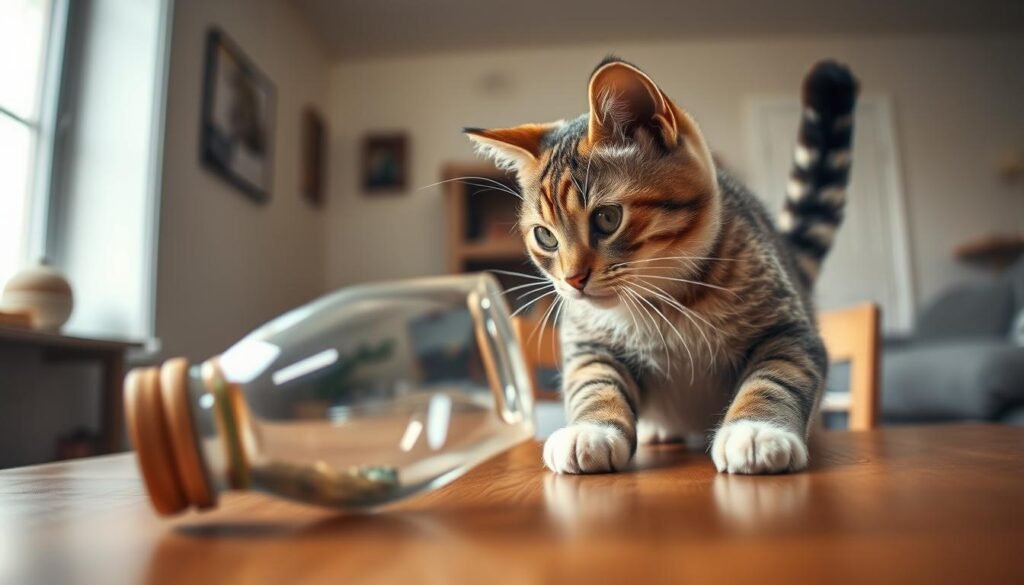
When your cat knocks over a mug, you might think it’s out of spite. But, science and cat behavior tell a different story. There are three main reasons: an inherited hunting instinct, natural curiosity, and a desire for attention. Knowing these reasons helps you understand your cat better and respond calmly.
Instinctive hunting and evolution
Cats have a hunting sequence passed down from their wild ancestors. They stalk, paw, and then pounce to test their prey. Small items like bottle caps or pens act as prey, mimicking movement and size.
Pawing helps your cat learn about texture and motion. It’s a way for them to test if something moves or can be caught.
Curiosity and experimentation
Cats are naturally curious and love to explore objects you use. They study things like your glasses or phone to understand cause and effect. A small nudge that makes something move triggers their hunting instinct.
Each time they experiment, they learn about gravity, sound, and different surfaces. It’s like how toddlers learn by touching and exploring.
Attention-seeking and learned responses
Knocking things over can be a way for cats to get your attention. Any reaction you give, whether it’s praise or a scold, teaches them. They notice patterns, like if knocking over a phone makes you look up, they’ll do it again.
They also do this to create usable space, like knocking items off high shelves to make perches.
- Predatory instinct drives the batting and pouncing sequence.
- Curiosity fuels repeated testing and exploration of household items.
- Attention-seeking reinforces knocking objects when interaction follows.
Cat behavior and psychology behind toppling items

When your cat knocks over a glass, it’s not just a joke. Understanding cat behavior and psychology helps you understand their actions better.
Watch when your cat knocks things over. Indoor cats often do this at dawn and dusk, when they’re most active. Kittens and young cats have lots of energy, while older cats might knock things to get your attention. Cats that love to play will often target moving or shiny objects.
Stress and anxiety can make a cat act out of character. Things like moves, visitors, loud noises, or fights with other cats can cause this. Look for signs like hiding, grooming too much, or changes in appetite.
Not getting enough to eat or play can also lead to knocking things over. Try giving your cat more playtime and adjusting their feeding schedule if they’re active at night.
Some cat breeds, like Bengals and Siamese, are naturally curious and active. Senior cats might start knocking things over if their mind or eyesight is changing. Always talk to your vet if your cat’s behavior changes suddenly or gets worse.
Every cat is different, just like people. Some cats are bold explorers, while others are shy and careful. Keep track of when your cat knocks things over, what they target, and any big changes in their life to figure out why.
| Driver | Common Signs | What to Watch |
|---|---|---|
| Boredom / Excess energy | Repeated item targeting, zoomies, night activity | Play frequency, toy rotation, pre-bedtime sessions |
| Stress / Anxiety | Sudden onset, hiding, appetite change | Recent home changes, visitors, inter-cat tension |
| Age-related | Kittens: exploratory knocking; seniors: confusion | Vet check for senior cognitive decline or sensory loss |
| Breed / Personality | High-energy breeds more persistent | Match enrichment to breed traits and individual needs |
| Hunger / Feeding routine | Early morning table-clearing, increased vocalizing | Adjust portions, try scheduled feeders, monitor weight |
Household mischief: practical tips to stop knocking objects
Small changes in your home can make a big difference. Start by making shelves stable and moving fragile items into cabinets. Choose sturdy items like ceramic planters or cat grass for windowsills. This helps protect your valuables and reduces the chance of your cat knocking things over.
Use simple cat-proofing methods to stop your cat from targeting edges. Apply double-sided tape, aluminum foil, or tactile deterrents on ledges. Place clear barriers or weighted mats on surfaces you can’t watch. If your cat likes perches, offer a safe high shelf or a tall Armarkat tree.
Enrichment and redirection help meet your cat’s hunting instincts. Schedule two short play sessions a day that mimic stalking and pouncing. Try feather wands, TRIXIE activity boards, or Nina Ottosson puzzle toys. Rotate toys every few days to keep things interesting.
Use puzzle feeders and automatic feeders to manage food-related knocking. A Catit Senses or a Frisco interactive toy can keep your cat busy while you cook. Place a puzzle feeder near a window perch for a fun feeding spot.
Training with positive reinforcement changes behavior without stress. Use a clicker or treats when your cat uses a toy or shelf instead of a tabletop. Reward calm behavior and have everyone follow the same routine. Over time, your cat will learn that play and attention come from approved activities, not from knocking things over.
When your cat taps a glass or bowl for attention, use redirection and mild negative punishment. Stand, remove attention, and then offer a toy or a short play burst. Ignore attention-seeking knocks instead of scolding. This teaches your cat that knocking objects won’t get the desired result, while enrichment and training show better options.
Start with a quick daily plan: clear tempting items from edges, add two 10–20 minute play sessions, place one puzzle feeder and one high perch, and reward toy and shelf use. Consistent cat-proofing, enrichment, redirection, and training reduce incidents of household mischief. It helps your cat feel engaged and secure.
Expert insights, science facts, and fun facts about feline habits
When your cat knocks over a glass or pushes a plant, you might feel frustrated. Experts say to gently guide them away from trouble instead of scolding. They suggest daily play, puzzle feeders, and tall places for your cat to climb.
What behaviourists and vets say
Experts say cats love to move and find new things to play with. This activity triggers their hunting instincts. If your cat starts knocking things over more, it could be a sign of health issues.
Science-backed takeaways
Studies show that cats paw at things to test them, just like they would with prey. Knocking objects helps them learn about cause and effect. Positive reinforcement and play can change their behavior for the better.
Fun facts and quick tips
- Fun facts: Cats have scent glands in their paws, so touching objects helps mark territory.
- Quick tip: A 15–20 minute pre-bedtime “hunt” with toys often cuts down nocturnal knocking.
- Shopping tip: Choose durable sisal and treated wood for cat trees; brands like Catit, Nina Ottosson, Armarkat, and Frisco get veterinarian and RSPCA mentions for quality.
Final thoughts for living with a curious cat
Living with cats means accepting some mischief as part of daily life. Cats have a natural urge to bat and swipe at things. This is a mix of hunting instinct, curiosity, and a bid for attention.
When playful cats tip a glass or send a picture frame tumbling, it’s often less about spite. It’s more about basic drives and boredom.
You can reduce toppling items with a few steady habits. Move fragile pieces out of reach. Add a vertical perch and a puzzle feeder.
Do two short hunt-style play sessions each day for 15–20 minutes. Use positive reinforcement to reward the behaviours you want. Gently ignore attention-seeking knocks so your cat learns what works.
If you’re feeling cat owners’ frustration, remember that simple changes help. Enrichment, routine feeding, and interactive toys give your cat safer outlets for energy. If the behaviour appears suddenly or grows worse, book a vet check.
Think of table-clearing as an expression of a clever predator’s nature. With a few practical steps, you’ll protect your home and keep your cat happier. Living with cats can be less stressful and more joyful when you meet their needs.