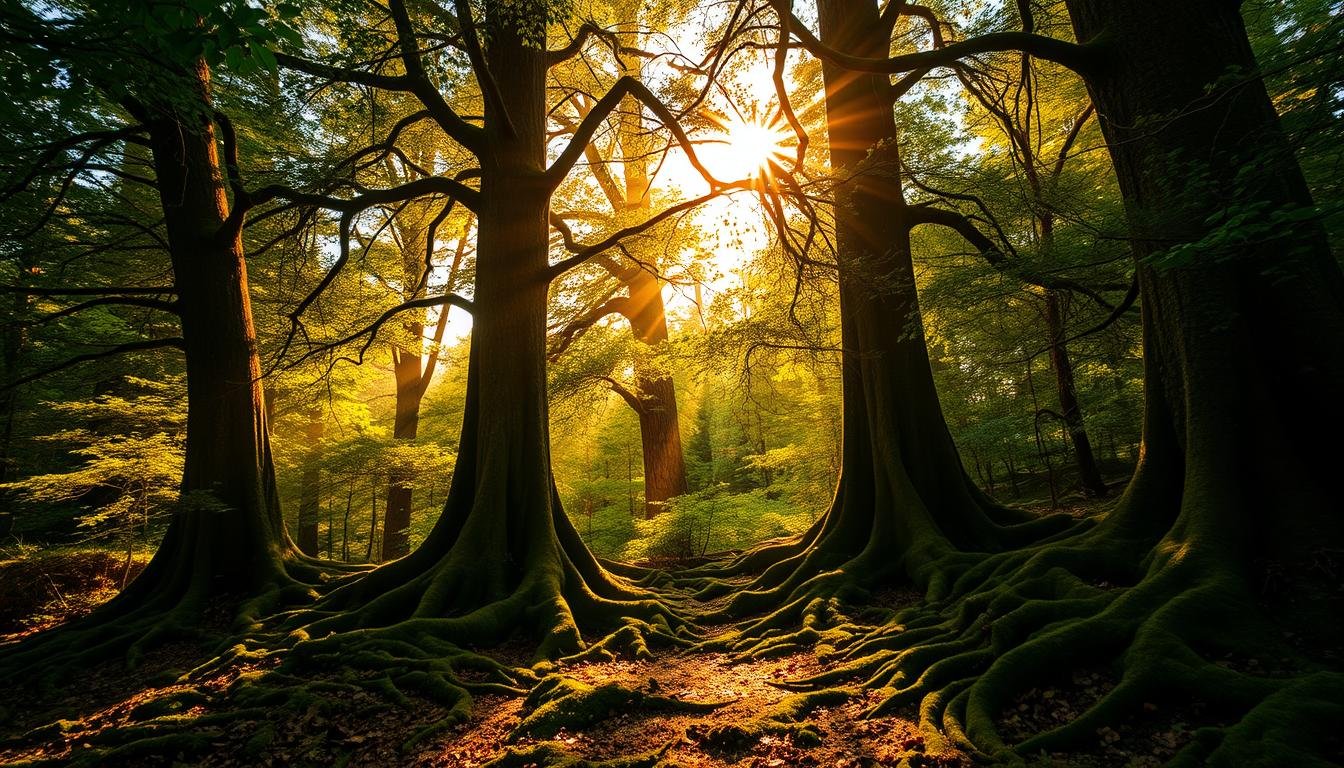
Have you ever stood in a forest and felt a deep sense of mystery? Trees are more than just silent giants. They are living, breathing communities with amazing stories to tell. The hidden life of trees shows us a world of communication and intelligence we never thought possible.
Imagine walking through an ancient forest where every tree is connected. They share information, support each other, and respond to their environment in incredible ways. Forest communication is not just a scientific idea. It’s a stunning discovery of nature’s complexity.
Trees have amazing abilities that make them seem almost alive. They talk to each other through chemical signals, electrical impulses, and their roots. Scientists have found that trees can warn each other of dangers, share nutrients, and even recognize their own kids.
Key Takeaways
- Trees are intelligent, communicative organisms
- Forest networks operate like complex social systems
- Trees can send warning signals and share resources
- Underground root systems create massive communication networks
- Each tree plays a vital role in its ecosystem
The Secret Language of Forest Communication
Trees are not just silent giants in the forest. They talk to each other in complex ways. This shows how smart woodland ecosystems are.
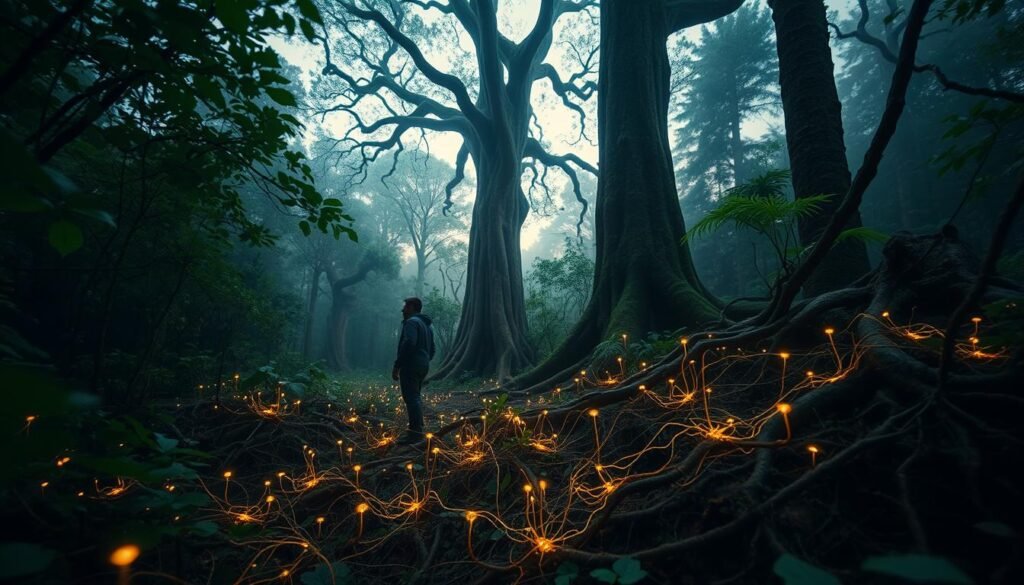
The wood wide web is like nature’s superhighway. It connects tree roots through fungal networks. This lets trees share resources and warnings over long distances.
Chemical Signals and Warning Systems
When a tree faces danger, like insects, it acts. It sends out chemical signals to warn others. This helps nearby trees get ready for threats.
- Release of defensive compounds
- Rapid communication through root systems
- Coordinated protection strategies
Underground Communication Networks
Mycorrhizal fungi create a special network under the forest. They link tree roots, allowing for sharing and information exchange. Trees can share nutrients, water, and warnings through these connections.
| Communication Method | Purpose | Speed |
|---|---|---|
| Chemical Signals | Threat Warning | Minutes |
| Electrical Impulses | Resource Coordination | Seconds |
| Fungal Network | Nutrient Sharing | Hours |
Electrical Impulses Between Trees
Scientists found that trees can send electrical signals like animals. These signals go through root networks. They help trees share info about their surroundings and dangers.
Trees are social beings that communicate and cooperate in sophisticated ways.
Learning about forest communication opens up a world of connection and support. It shows that each tree is part of a living community, not alone.
How Trees Create Living Communities

Forest ecosystems are much more complex than we think. Trees don’t live alone; they are part of a big social network. This network shows how plants can communicate and help each other.
Trees form communities in many ways:
- Sharing nutrients through underground root networks
- Exchanging chemical signals for defense and communication
- Supporting weaker or younger trees in their ecosystem
Tree sentience is clear when we see how they interact. Older trees act like parents to younger saplings. They share important resources through their roots. This network, called the Wood Wide Web, lets trees talk and help each other in amazing ways.
“A forest is not a collection of trees, but a complex, living community.” – Forestry Research Team
In these ecosystems, trees work together in incredible ways. They warn each other of dangers, share water in dry times, and give nutrients to those in need. This shows how smart plants can be.
Seeing trees as living beings helps us appreciate their secret lives. It shows us the complex world that exists beneath our feet.
The Hidden Life of Trees: Underground Connections and Support Systems
Under the forest floor, a secret world of underground communication exists. This world challenges our understanding of plant life. The underground tree network is a complex system that connects trees in ways we’re just starting to grasp.
Trees are not just passive beings. They actively participate in an ecosystem of communication and support.
Picture a hidden world where trees talk and share resources through mycelium connections. These underground paths are like nature’s internet. They allow trees to exchange nutrients, send warnings, and support each other in magical ways.
Mycorrhizal Fungi Networks
Mycorrhizal fungi create an underground highway that links trees across entire forests. These tiny networks do more than just connect trees. They enable plant intelligence in amazing ways:
- Transfer nutrients between different tree species
- Send chemical warning signals about threats
- Support younger or weaker trees by sharing resources
Root System Intelligence
Tree roots are complex communication systems. They can recognize their own species and even genetic relatives. They make decisions about resource sharing and protection, showing a level of plant intelligence that challenges our views of vegetation.
Nutrient Sharing Mechanisms
The underground tree network works like a complex social system. Older trees often care for younger ones by sharing water, nutrients, and survival information. This happens through the detailed mycelium connections.
Tree Memory and Intelligence
Trees are much more complex than we think. They have a special ability to remember and react to their surroundings. This shows a deep form of memory that changes how we see plants.
Scientists found that trees can recall past events and change how they act. This tree memory shows up in many interesting ways:
- Drought survival strategies
- Defensive chemical production
- Growth pattern modifications
- Threat recognition and response
When a tree faces a tough situation like a drought, it doesn’t forget. It learns to handle it better next time. Plant intelligence lets trees make memories to get ready for future challenges.
Researchers have seen trees change their chemicals and roots based on past experiences. These changes show a smart form of learning that’s more than just reacting.
Trees are not passive organisms, but dynamic, intelligent beings capable of complex communication and strategic survival.
Seeing trees in a new light after learning about their memory and smart responses is a game-changer. They are living, learning beings that keep adapting to their world in ways we’re just starting to understand.
Forest Ecosystems and Tree Relationships
The forest is more than just trees standing together. It’s a complex community where trees talk, help, and protect each other. This hidden network shows how trees work together, challenging our views on plant life.
Trees have amazing ways to survive and help each other. They use a secret language to share resources, warn of dangers, and care for their young.
Parent Trees and Offspring Care
Older trees in the forest act like parents to younger ones. They support them through underground roots by:
- Sharing nutrients with younger saplings
- Protecting seedlings from harsh conditions
- Transferring water and minerals
Cooperative Defense Strategies
When danger comes, trees don’t face it alone. They send chemical signals and electrical impulses to warn others about threats like insects or disease.
| Defense Mechanism | Purpose | Communication Method |
|---|---|---|
| Chemical Signaling | Warn about insect invasions | Airborne chemical messages |
| Root Network Alerts | Share disease warnings | Underground fungal connections |
| Stress Response Sharing | Prepare neighboring trees | Electrical impulse transmission |
Community Support Among Species
Different tree species in the forest don’t just live together. They actively support each other. Symbiotic relationships help trees form strong, connected communities. These communities can face challenges better than single trees.
The Impact of Human Activity on Tree Communities
Your actions have a big impact on the hidden life of trees. Forests are complex networks that can be hurt by human actions. Deforestation doesn’t just remove trees—it breaks down entire communities with deep connections.
Modern human actions challenge the communication systems of trees. Tree communication networks can be badly hurt by activities that split forests and destroy key connections between plants.
- Logging disrupts mycorrhizal fungi networks
- Climate change alters traditional forest communication patterns
- Urban expansion breaks underground support systems
Understanding how forests are connected shows how human actions affect trees. Mycorrhizal fungi, which help trees talk to each other, can be destroyed quickly. This breaks networks that took centuries to build.
| Human Activity | Impact on Tree Communities |
|---|---|
| Deforestation | Destroys communication networks |
| Climate Change | Disrupts traditional survival strategies |
| Urban Development | Fragments forest ecosystems |
To protect these complex forest networks, we need to understand their complexity. Trees are not alone; they are part of interconnected communities. These communities communicate and support each other in amazing ways.
Ancient Trees and Their Survival Strategies
Trees are amazing at surviving, using incredible strategies that show their sentience and intelligence. They have learned to thrive in tough environments. This shows their ability to adapt and protect themselves.
Natural Defense Mechanisms
Nature has given trees advanced defense systems. These systems help them fight off threats. They include:
- Producing toxic chemical compounds to repel insects
- Creating thick bark to shield against physical damage
- Developing complex root networks for stability
Adaptation to Environmental Changes
Trees can change to fit new environmental conditions. Their intelligence lets them adjust growth, save resources, and tackle climate changes with great skill.
“Trees are silent witnesses to environmental transformation, adapting without moving an inch.” – Forest Ecology Research Team
Long-term Survival Techniques
Some ancient trees have lived for thousands of years. They use survival strategies like:
- Developing resilient genetic variations
- Creating symbiotic relationships with surrounding organisms
- Storing nutrients during abundant periods
The survival strategies of trees reveal a complex world of intelligence far beyond our traditional understanding of plant life.
What We Can Learn from Trees: The Wisdom of the Forest
The hidden life of trees teaches us about community, resilience, and being connected. Exploring forest communication shows us trees’ survival and support strategies. These can inspire human societies.
Forest ecosystems show the strength of working together. Trees don’t fight alone; they form networks to share and protect each other. They communicate through roots. This teaches us that success comes from teamwork, not just individual effort.
Learning from trees’ communication methods can change how we care for the environment and interact with each other. Trees show us that being strong comes from supporting one another. This helps us face challenges and build lasting relationships that keep ecosystems healthy.
Scientists like Peter Wohlleben have shown trees are smart and respond to their surroundings. Their ways of surviving teach us a lesson. When we work together, share, and see our connections, we can build better, more caring communities. These communities can live in harmony with nature.